

The promise of conversational AI rests on naturalness. A voice agent sounding robotic, or even worse, monotone while mispronouncing key terms, reduces user trust and crashes the interaction, no matter how good the logic is.
In the world of software testers, QA for TTS systems has moved light-years beyond mere intelligibility. The new benchmark for quality is human-likeness. To achieve this requires developers to tap into sophisticated, context-aware models that can handle the subtlety of prosody and inflection. And for that to work, testers need structured, repeatable checks that go deep into the auditory experience.
The Technical Failures Behind the Robotic Voice
Three main technical deficiencies were responsible for the commonality of that “robotic” voice associated with older TTS models:
- Monotonous Prosody: Prosody concerns the rhythm, stress, and intonation of speech. A flat, robotic voice doesn’t vary its pitch-that is, its fundamental frequency, or F0-to mark questions, emphasis, or the end of a sentence.
- Handling Linguistic Error: The voice does not apply context appropriately. For example, it mispronounces homographs, such as “read” vs. “read,” or it may imply the wrong tone for sarcasm or urgency.
- Synthesis Artifacts: These are audible clicks, glitches, or unnatural breath sounds and can be due to poor training data or inefficient waveform generation.
To solve these issues, modern, high-performance TTS platforms employ lightweight, context-aware neural architectures. One of the leading examples is the Murf Falcon API, engineered to bypass these constraints by focusing on conversational prosody and achieving high benchmarks, such as 99.38% pronunciation accuracy. When a model addresses core quality issues at the architecture level, QA teams can shift their focus from catching basic errors to validating real-world, human-like subtlety.
Fundamentals of TTS Naturalness Testing
Evaluation of the quality of TTS depends on both objective and subjective measures.
Objective tests are done through automated tools:
- WER calculates the intelligibility of a TTS system by feeding its output back into an ASR, and transcription errors are computed. Smaller values are better.
- MCD (Mel-Cepstral Distortion): It evaluates the spectral difference between the synthesized voice and the human reference. A lower score means higher fidelity.
However, objective metrics alone cannot capture all the subtleties of human perception. Here is where subjective listening tests come into their own. The gold standard is the Mean Opinion Score (MOS), based on human listeners’ rating of naturalness on a 5-point scale. For QA teams in continuous delivery pipeline environments, a fast and lightweight “MOS-Lite” approach is more practical.
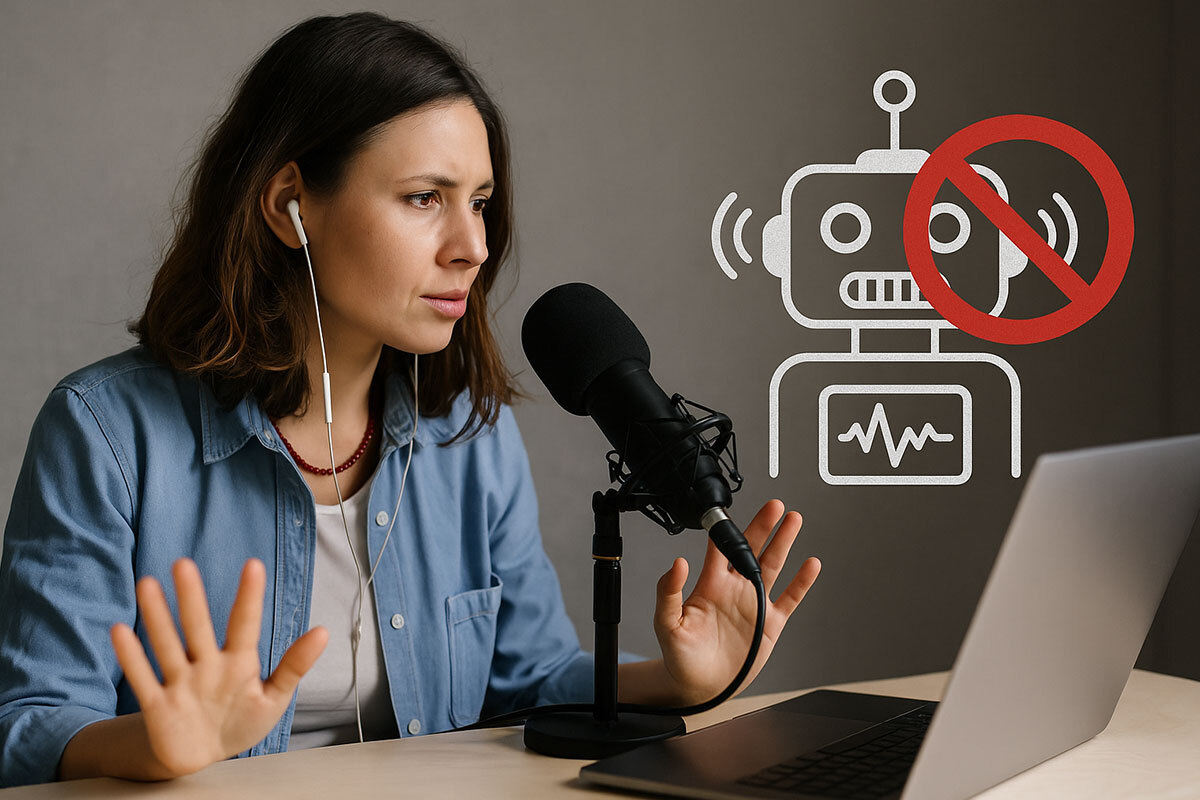
5 Easy Tests for Naturalness
These tests will translate core acoustic and linguistic challenges into simple and repeatable checks for any QA professional.
- The MOS-Lite Quick Check
This is the most straightforward type of subjective testing. Give a common script to the listener, or a small QA group, and request that they grade the voice on a 1-5 scale on the following:
| Score | Description |
| 1 | Robotic and difficult to understand |
| 2 | Noticeably synthetic and poor flow |
| 3 | Generally acceptable but slightly slow or monotonous |
| 4 | Very natural and no noticeable flaws |
| 5 | Indistinguishable from humans |
Goal: Achieve an average score of 4.0 or higher MOS. Scores below 3.5 indicate significant quality failure. This test is a quick, universal pass/fail benchmark for user perception.
- Prosody (the Contextual Tone Test)
Prosody, the music of language, is crucial. Robotic voices frequently read punctuation symbols, such as question marks, with the wrong pitch.
Test your script. Employ pairs of sentences, identical except for punctuation, tone, or emphasis.
Example 1: “This is the final report.” (Statement, falling tone). vs. “This is the final report?” (Question, rising tone).
Example 2: “I need a long pause, and then the next step.” (Check for appropriate length pause after the comma).
Goal: Confirm the pitch and stress match the linguistic intent. Failure here shows a model that is contextually unaware.
- The Stress and Homograph Test
While models might attain high general pronunciation accuracy, their performance often breaks down on ambiguous or domain-specific words.
Test your script by creating sentences containing words that have the same spelling but are pronounced differently depending on their part of speech (homographs), acronyms, or numbers.
Example 1 (Homograph): “Did you read the book?” versus “The sign says READ the instructions.”
Example 2 (Acronym/Number): “The meeting is at 4:00 PM with the CTO of NASA.”
Objective: The model should pronounce these elements correctly without any prior phonetic guidance. High-quality systems are benchmarked against success in digits, acronyms, and context, and this test is a very strong differentiator between them.
- The Artifact & Pacing Test
This test focuses on auditory cleanliness and rhythm. Robotic voices often have two key flaws: inappropriate pauses and audible synthesis artifacts.
Check for artifacts by listening specifically for clicks, hisses, abrupt volume changes, or an “echo” that sounds like a double-read. Artifacts signal a poor-quality waveform generator.
Make sure words transition smoothly (coarticulation), and any pausing occurs after a natural breath point or punctuation. Most robocall outputs have a common robotic flaw of pausing inside a phrase in a place where a human would continue their speech.
Goal: Confirm clean, uninterruptive audio with a natural speech rhythm, as if controlling one’s breath.
- Auditory Fatigue Test – Endurance
A voice that initially sounds “fine” for two sentences becomes grating after five minutes. This is an important test for applications like audiobooks, long e-learning modules, or automated call center spiels.
- Testing Methodology: Listen to one continuous script for a minimum of five minutes without stopping.
- Listener Feedback Focus: Is the listener bored? Is the rhythm too predictable? Does the voice fail to offer any emotional shift where the text demands it?
Goal: The voice has to keep the listener engaged and not create auditory fatigue. A natural TTS voice, designed to be expressive, would remain pleasant and easy to understand throughout a long listening period.
The Bottom Line
Testing naturalness has become one of the most important parts of QA, as it moves from simple intelligibility checks to complex, perceptual validation. It is by implementing structured subjective tests such as the MOS-Lite, the Contextual Tone Test, and the Auditory Fatigue Test that QA professionals will be able to drive out the robotic flaws systematically, which erode user trust.
Which objective or subjective tests does your team consider essential elements in the TTS validation pipeline? Please share your methodology in the comments below!