Software Testing Magazine: Load Testing, Unit Testing, Functional Testing, Performance Testing, Agile Testing, DevOps
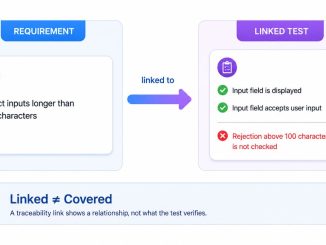
A fully green traceability matrix can make it look as though requirements are properly covered. Yet a link between a requirement and a test does not prove that the test actually verifies every required behavior. Requirements coverage gaps can remain when tests are incomplete, when a requirement evolves without its tests following, or when a test changes while its traceability link remains intact. This article proposes a simple way to detect them: first understand how they arise, then structure the review by comparing explicitly required behaviors with what the linked tests actually demonstrate.
Today, you can find tools that generate code and AI-assisted test automation tools that will handle the quality assurance part. Is it the death of traditional manual testing? In this article, Rimpal Mistry reminds us that human validation is still needed to provide the final check of delivered software.
Like code, you can ask AI to generate your unit tests. But what about the quality of the resulting scripts. Who is going to check the coverage of the resulting to these automated tests? This article discusses the issue of ensuring that every AI-generated unit test contributes unique value is becoming the real challenge.
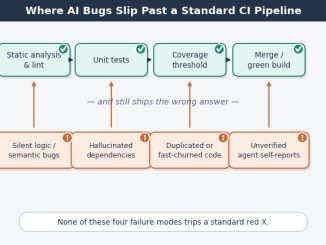
AI-written code can sail straight through your CI pipeline — lint clean, tests green, coverage above threshold — and still ship a bug nobody thought to test for. This article breaks down why AI code passes Continuous Integration (CI) checks built for a different generation of bugs, and lays out a short list of concrete, budget-free gates that catch what your CI pipeline can’t see today.
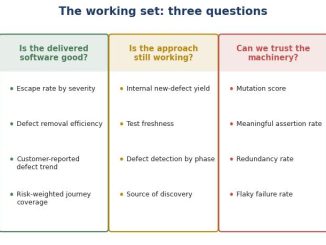
Metrics exist to answer two questions: how good is the software we deliver, and is our testing approach actually working? AI-generated tests broke the old answers to both. QA metrics were never really about numbers. They exist to answer two questions. First, how good is the software we are delivering to customers? Second, is our testing approach actually working, or are we just going through the motions?
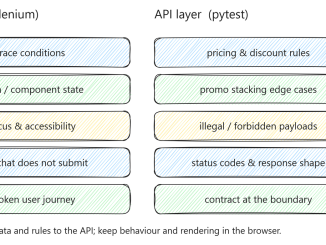
In this article, Mikhail Golikov, the sole QA on a seven-team backend e-commerce platform, explains where each regression check belongs, in the browser or at the API. He shares the rule he actually uses, two bugs that only one layer could have caught, and the realization that finally made his browser suite small and stable.
As AI makes test creation nearly effortless, software teams face a new challenge: determining which tests actually improve quality and which simply add noise.