
Software testing has always been about ensuring reliability finding bugs before users do, validating performance, and maintaining software quality under pressure. But the way testing is done today is shifting rapidly.
Artificial intelligence (AI) is no longer just supporting development workflows. It is now actively reshaping the software testing and software quality assurance (QA) processes.
According to McKinsey, 55% of organizations now use AI in at least one business function, and QA is becoming one of the most impacted areas. Testing is moving from manual-heavy validation toward intelligent, automated, and predictive systems.
This shift is not cosmetic. It is structural.
AI is changing how tests are written, executed, prioritized, and even how defects are predicted before they occur.
The Changing Role of AI in Software Testing
Traditional software testing relied heavily on manual effort writing test cases, executing them, and reporting bugs after they appeared.
Now, AI-powered tools are changing that sequence.
GitHub found found that developers using AI-assisted tools complete tasks significantly faster, and this productivity gain extends directly into QA workflows. Test creation, debugging, and regression testing are becoming faster and more automated.
Instead of manually designing every test case, QA engineers now work alongside systems that suggest test coverage, identify missing edge cases, and even generate test scripts automatically.
The role of testers is shifting from execution to oversight and strategy.
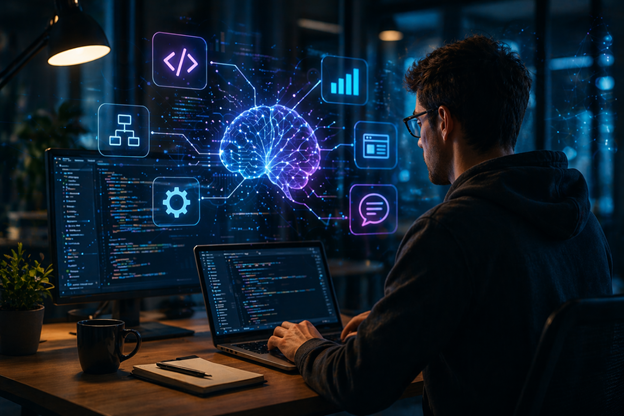
How AI is Rebuilding Software Testing Ecosystems
AI is not replacing software testing it is restructuring how it works at every level.
1. Smarter Test Case Generation
AI tools can analyze application behavior and automatically generate test cases based on user flows, historical defects, and system changes.
This reduces dependency on manual test design and improves coverage.
2. Predictive Defect Detection
Instead of waiting for bugs to appear in production, AI models can predict high-risk modules by analyzing code changes, past failures, and system complexity.
This allows QA teams to focus on areas most likely to fail.
3. Automated Regression Testing
Regression testing, an activity that was once time-consuming, is now increasingly automated. AI selects and prioritizes test cases based on impact analysis, reducing redundant execution and decreasing risks of regression.
4. AI in QA Operations and Workflow Optimization
Modern QA pipelines are integrating AI-driven prioritization, helping teams decide what to test first, what to automate, and what to ignore based on risk level.
AI in Real-World QA and Testing Environments
In practice, AI is already deeply embedded in testing workflows.
AI assisted tools and QA intelligence platforms now help teams identify failure patterns, prioritize test execution, and optimize release cycles by analyzing real-time software behavior.
Instead of static test plans, QA teams now operate with adaptive testing strategies that evolve with every code change.
Faster Feedback Loops in Software Quality
One of the biggest shifts AI brings to testing is speed.
Industry reports show that AI-driven testing systems can significantly reduce the time required to identify and resolve defects by automating test execution and log analysis.
This creates faster feedback loops between development and QA teams, ensuring bugs are detected earlier in the lifecycle rather than in production.
The result is not just faster testing but better software stability.
AI Adoption Beyond Large Enterprises
AI in software testing is no longer limited to big tech companies.
The U.S. Chamber of Commerce reports that 98% of small businesses now use at least one AI-enabled tool, many of which include testing, automation, or quality-related features in their workflows.
From startups to enterprise teams, AI is making structured testing more accessible, even without large QA departments.
Challenges in AI-Driven Testing
Despite its advantages, AI in testing is not without challenges:
- Over-reliance on automated test generation can miss business-critical scenarios
- AI models depend heavily on training data quality
- Human oversight is still required for complex edge cases
- Integration with legacy systems can be difficult
AI improves testing, but it does not eliminate the need for skilled QA professionals.
The Future of Software Testing with AI
Software testing is evolving from a reactive process into a predictive and continuous system.
AI will increasingly:
- Predict failures before they occur
- Self-heal broken test scripts
- Optimize test coverage dynamically
- Reduce redundant testing cycles
As adoption grows, QA will become less about execution and more about decision-making and strategy.
Conclusion
AI is fundamentally reshaping software testing and quality assurance.
From automated test generation to predictive defect analysis, testing is becoming faster, smarter, and more adaptive.
According to McKinsey, GitHub found improvements in developer productivity, and Industry reports continue to show rising efficiency gains from AI adoption in testing environments.
As organizations scale their use of AI tools and QA automation platforms, software testing is shifting toward a continuous, intelligent, and proactive model.
Even the U.S. Chamber of Commerce highlights widespread AI adoption across businesses of all sizes, reinforcing that this transformation is not limited to large enterprises.
The future of software testing is clear: less manual repetition, more intelligent validation, and stronger software quality driven by AI-assisted decision-making.
Conclusion
This article explores how AI is transforming software testing and software quality assurance by improving test case generation, accelerating regression testing, and enabling predictive defect detection. It highlights how AI-driven tools enhance testing efficiency, reduce manual effort, and improve software reliability through faster feedback loops and smarter test prioritization. The piece also discusses real-world adoption across organizations of all sizes and outlines the future of QA as a more automated, continuous, and intelligence-driven process.