

There are many cases where AI models that worked fine in development start to behave badly in production. In this article, Kanika Vatsyayan discusses the causes that lead to this situation. He recommends moving from static assessments to continuous quality engineering for AI models.
Author: Kanika Vatsyayan, BugRaptors, https://www.bugraptors.com/
Academic evaluation suites celebrate clean milestones: an 88% score on MMLU, top-percentile GSM8K reasoning accuracy, and flawless Python generation on HumanEval. Engineering signs off, release candidates, clear staging checks, and the model goes live.
Within weeks, runtime defects the surface. Support systems hallucinate unauthorized return policies; copilots emit malformed API payloads that freeze downstream services, and retrieval engines confidently serve outdated documentation.
These models did not degrade; they operate as designed. The root cause is a fundamental mismatch: static AI benchmark testing measures isolated capabilities in a sterile environment, while live applications demand continuous, full-lifecycle AI model testing across distributed, stateful software.
What Causes AI Models to Break in Real Environments?
Traditional enterprise software breaks on explicit syntax errors, unhandled exceptions, or database query timeouts. Machine learning applications can fail silently while executing clean code, returning valid HTTP 200 responses and passing simple string-formatting checks.
When probabilistic models interface with stateful enterprise architectures, runtime failures typically emerge across four distinct operational surfaces:
- Fabricated Business Logic: Large language models can generate ungrounded claims with great mathematical certainty, including false warranty exceptions, discounts, or transaction records.
- Orchestration and Tool Errors: An agent may pick the proper business action but fail downstream execution by mistransposing JSON schema arguments, failing data-type validations, or triggering duplicate API calls after unhandled network timeouts.
- Covariate and Input Drift: Production query distributions will not match training baselines. Accuracy degrades without a single server error when user terminology, prompt complexity, or conversational context changes.
- Adversarial and Security Vulnerabilities: Agents with the ability to take actions might be susceptible to prompt injection, jailbreaks, and sensitive data leaks when user inputs are not sanitized, an issue that traditional static analysis security testing (SAST) methods cannot identify.
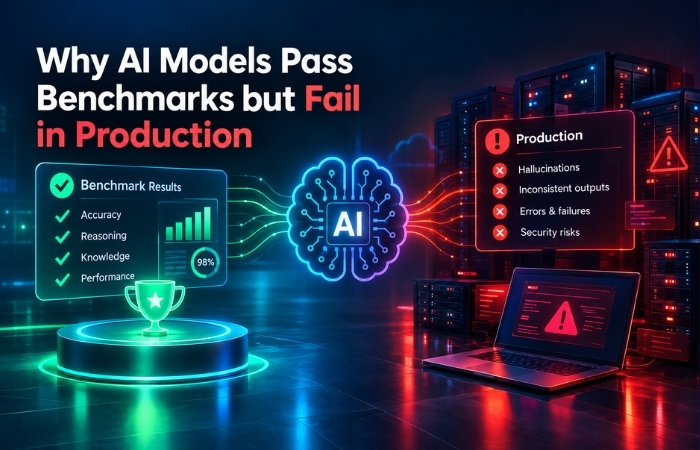
Why Academic Benchmarks Miss Critical Production Flaws
Public leaderboards rely on curated, static datasets evaluated in a closed environment. Relying solely on AI benchmark testing creates a false sense of security because academic scorecards mask the operational bottlenecks that break live production software.
Retrieval Noise and Hallucinations in RAG Contexts
Benchmarks evaluate clean, single-turn prompts with explicitly framed instructions. Production models rarely operate in isolation. In Retrieval-Augmented Generation (RAG) architectures, prompts are dynamically assembled from vector databases, conversation histories, and system instructions.
If an embedding search retrieves two conflicting policy documents alongside outdated guidance, the model synthesizes them into an authoritative hallucination. Standard benchmarks evaluate whether a model knows isolated facts, whereas real-world AI model testing must assess whether the system can filter through noisy, poorly chunked enterprise context without hallucinating.
Schema Errors and Timeout Retries in Tool Execution
Evaluating text generation measures token probability, not deterministic software integration. In production systems, models act as orchestrators: they classify intent, extract structured variables, and invoke external APIs.
A model may demonstrate near-perfect reasoning on a benchmark, but if it outputs an unescaped double quote inside a JSON payload, downstream microservices crash. Furthermore, when an autonomous workflow encounters network latency or an API timeout, it may blindly retry the request, triggering duplicate database writes or repeated financial transactions. Rigorous AI model testing ensures the model’s structured outputs respect API contracts under real-world network latency.
Covariate Shift from Dynamic User Traffic
Static evaluation sets assume a fixed, immutable data distribution. Real user traffic is dynamic. Production users introduce ambiguous phrasing, typographical errors, multi-page pasted logs, and adversarial instructions.
Over time, live user interactions drift away from the original test distribution. The model’s internal weights remain identical, yet its accuracy and relevance decline silently without triggering traditional error alarms.
How to Test AI Systems Before Production Release
Bridging the benchmark-to-production gap requires treating the AI model as an unpredictable, probabilistic component embedded within a distributed software architecture. Shifting from isolated prompts to continuous integration requires establishing structured pipelines for AI model validation, ensuring non-deterministic behaviors are systematically audited before reaching end users.
Balancing Strict Schema Tests with Semantic Quality Metrics
Traditional QA uses exact equality checks (assert response.code == 200). Applying exact string matching to conversational or agentic workflows creates brittle test suites that break on harmless linguistic variations, or loose assertions that allow hallucinations to slip through unnoticed.
Engineering teams must split their validation pipeline into two distinct assertion layers:
- Deterministic Contract Testing: Enforce strict assertions on structured outputs. If an AI workflow invokes an external API, validate parameter types, JSON schemas, required attributes, and transaction ceilings.
- Probabilistic Semantic Evaluation: Evaluate unstructured natural language outputs using reference-guided AI model evaluation metrics across standardized golden datasets.
Curating Versioned Golden Datasets from Edge Cases
Scrap the assumption that generic public benchmarks reflect operational reliability. Effective pre-release AI model testing requires QA teams to build and maintain version-controlled golden datasets composed of verified domain scenarios:
- Operational Happy Paths: Standard business transactions and frequent user queries.
- Boundary and Edge Cases: Missing parameters, contradictory instructions, and empty context payloads to verify graceful refusal behavior.
- Historical Regression Scenarios: Sanitize every production hallucination, tool failure, or policy bypass and convert it into a permanent regression test case in the CI/CD pipeline.
Stressing Guardrails with Chaos and Adversarial Fuzzing
Resilience is proven when underlying dependencies fail. Quality engineers should deliberately inject errors into model interfaces during staging:
Return simulated HTTP 500, 502, and 504 status codes from tool APIs to verify that the orchestration engine logs the error and escalates cleanly rather than entering infinite retry loops.
Inject empty or contradictory context payloads into RAG pipelines to confirm the model returns a deterministic “insufficient information” refusal instead of fabricating details.
Run automated adversarial fuzzing suites to verify that prompt injection attempts (“Ignore previous instructions”) and malicious instructions embedded in retrieved files are intercepted by guardrails before reaching inference.
Post-Launch Telemetry: Tracking Silent Drift and Shadow Traffic
Testing cannot conclude at deployment sign-off. Because user inputs, upstream data repositories, and third-party model APIs evolve continuously, teams must prioritize ongoing AI testing in production.
- Shadow Deployments and Traffic Mirroring
When updating a system prompt, retrieval index, or foundation model version, deploy the change in shadow mode. Mirror live user queries through the candidate workflow with write operations disabled, allowing teams to compare decisions against current baselines without operational risk. This form of AI production testing validates model behavior against uncurated enterprise traffic.
- Telemetry and Statistical Drift Monitoring
Capture execution traces containing user queries, retrieved chunks, tool arguments, and output strings. Track distribution metrics like the Population Stability Index (PSI) and semantic vector embedding distances to catch covariate drift early. Sustained AI production testing ensures that a sudden drop in output similarity or a spike in tool-retry errors highlights system degradation long before it impacts users.
- Automated Guardrail Fallbacks
When real-time monitors detect anomalous, ungrounded, or non-compliant generations, the pipeline must redact the payload and return a predetermined fallback response. Flagged execution traces should automatically cluster and route into the pre-production regression suite for continuous remediation.
Moving from Static Benchmarks to Continuous Quality Engineering
High benchmark scores demonstrate a model’s general capability, not whether an application will operate reliably within enterprise software stacks. Treating probabilistic AI components like deterministic code leads to brittle architectures, runtime failures, and operational risk. Quality engineering teams must lead the transition from passive leaderboard tracking to disciplined systems engineering.
Reliable software shouldn’t depend on luck. Teams fix this by adding automated AI model evaluation gates to CI/CD pipelines, checking tool schemas, and separating strict rules from probabilistic outputs. Running continuous AI model testing across live infrastructure turns unpredictable AI behavior into dependable software.
About the Author
Kanika Vatsyayan, Vice-President – Delivery and Operations at BugRaptors, has over 10 years of IT experience in quality assurance, AI testing, and test automation. She specializes in quality strategy and emerging technologies, with a focus on driving innovation and delivering reliable software solutions.
Leave a Reply