
How AI Can Improve Insurance Verification Workflows
AI insurance verification uses artificial intelligence and workflow automation to help healthcare organizations confirm patient coverage, benefits, and authorization requirements.


Software Testing Articles & Tutorials: Load Testing, Unit Testing, Functional Testing, Performance Testing, Agile Testing, DevOps
AI insurance verification uses artificial intelligence and workflow automation to help healthcare organizations confirm patient coverage, benefits, and authorization requirements.

Did you know that 92% of customers check online reviews before purchasing anything? This means that app reviews are much more than just a measure of customer satisfaction. These reviews can also show errors and usability issues that might not be captured by your QA team.

Like code, you can ask AI to generate your unit tests. But what about the quality of the resulting scripts. Who is going to check the coverage of the resulting to these automated tests? This article discusses the issue of ensuring that every AI-generated unit test contributes unique value is becoming the real challenge.

Most systems fail politely under steady growth. Spikes work differently. A spike gives the team no ramp and no quiet hour to scale into. Here is why scheduled events keep breaking well-tested software, and what a spike test has to do that an ordinary load test skips.

For centuries, people have attempted to predict the future, from anticipating the outcomes of major political events and elections to betting on the financial prospects of a specific company or product. It is an activity that underpins our financial markets and drives advancements in countless modern sectors, as participants attempt to forecast specific future events while also frequently attempting to make some kind of profit along the way.
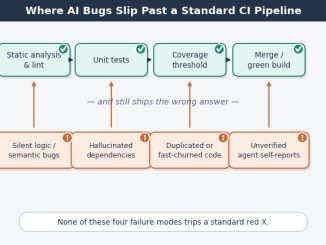
AI-written code can sail straight through your CI pipeline — lint clean, tests green, coverage above threshold — and still ship a bug nobody thought to test for. This article breaks down why AI code passes Continuous Integration (CI) checks built for a different generation of bugs, and lays out a short list of concrete, budget-free gates that catch what your CI pipeline can’t see today.

Reliability is increasingly difficult to define as technology gets faster, more connected and more adaptable. A platform that’s available every second of the year can still fail its users. Even if it delivers consistent results and responds in a predictable manner, it can be unreliable for the people who manage and run it. You have probably seen this happen.
Copyright © 2009-2026 Software Testing Magazine by Martinig & Associates